
In the Village Voice last month, some thoughts on Ben Folds, Snoop Dogg, and Dragonette.
In the Village Voice last month, some thoughts on Ben Folds, Snoop Dogg, and Dragonette.

In this week’s Village Voice, a feature on giving up formerly Brooklynite weirdo-pop duo High Places.
Bad news, folks: This new High Places album is easily their best yet. Since they no longer live here, this deals a blow to New York’s collective musical ego, which, quite frankly, might actually need a bit of a takedown post–”Empire State of Mind.” So here goes… More

Last month in the Village Voice, brief spots on Anamanaguchi (also covered previously), Alice In Chains, Alkaline Trio, Habib Koité (above), and Benga.

Two short items last month in the Village Voice’s concert calendar about Daniel Lanois and Little Boots. More of this to come.

Legendary hip hop producer Just Blaze just closed down his Baseline Studios facility, where a lot of crucial Jay-Z records were made over the past decade or so, and he sent out an open invitation for people to drop by on the last night. I went, and I was so struck by the way he was interacting with his fans that I wrote about it for the Village Voice.
A surprisingly small turnout all things considered (the extent of Just’s influence, in particular), but that just made it more intimate and personal: Just just sat around in his control room surrounded by everyone, giving demos on how to use his MPC and turntable, with a Rick Astley LP for the latter. (Biggest laugh of the night: He called one dude over to the MPC, only to be asked, “Hey, you got those Just Blaze sounds on there?”) Eventually he pulled together a quick and dirty beat for his fans to freestyle over, joking with them as he encouraged them all to join the cipher while rapping a little himself, liberally quoting Wu-Tang’s “Triumph,” and even reading lyrics off a flushed Queens fan’s phone. (“This is a once in a lifetime opportunity,” the latter gushed later.) More
I have a small spot this week with the Village Voice for the 2009 “Pazz and Jop” music critics’ poll.
 (Not me.)
There’s my ballot, of course, and Glenn McDonald’s usual statistical analysis (he was quite fittingly tapped by the Voice to run the official numbers this year), but also this time a short bit in the commentary portion of the program.
As a displaced second-generation, it warmed my heart a bit to see legendary Indian film composer A.R. Rahman finally get his due in the States thanks to the Slumdog Millionaire soundtrack, the ensuing performance during the Grammy Awards broadcast, and, of course, that crucial assist from M.I.A.’s tidy soundbite referring to him as “the Indian Timbaland.” It’s a shame, however, that it took six years to come up with a suitable follow-up to Jay-Z championing Panjabi MC. Come on, second-most-populous country in the world, get your act together. More
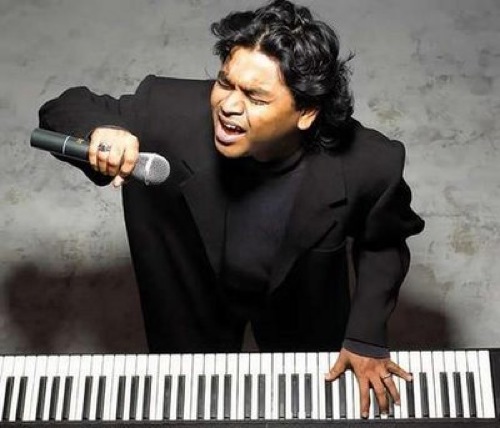 (Also not me, but getting warmer, I suppose.)
Since the Petey Pablo song is a good six years old at this point and “Jai Ho” as sung by the Pussycat Dolls makes me die a little inside with each masochistic tick of the iTunes play count (yes, I downloaded it, shut up), I’ll instead point you here to “Mann Chandre” from his decent (if ultimately not quite ballot-worthy) ’09 album Connections. I’m not so sure about the Voice’s section heading, which is “Yes, I ‘Actually’ Like It: More music to love, loathe, fear, and tragically fail to avoid,” but I’ll guess I’ll just assume the first option there unless explicitly told otherwise.
Now, I’ve voted before, but this time my guiding logic was a lot more interesting (a relative term there, I realize).
First, the unranked singles portion. I was far better equipped to handle that part this year, in large part because I’ve been closely following former Stylus Magazine writer Will Swygart‘s awesome new Singles Jukebox blog, in which he aggregates the scores and witty blurbs about current pop singles from his own fairly killer lineup of music critics; it’s a bit like a daily P+J pill, in a way. The Jukebox first crossed my desk around the time they skewered Parachute, a pop-rock band based in Charlottesville which I wrote about on several occasions for The Hook; it was both brutal and captivating, and I’ve been addicted ever since. The caveat here — and it’s a big one — is that I didn’t manage to get around to sifting through Pitchfork’s 2009 best-of yet. It’s been compiled into a single handy download, available via your favorite troublemaking website. Say what you must about other aspects of their editorial coverage — there’s some baggage there, at least — but I really can’t argue with the taste; 2007 and 2008 (also available via the same) were superb. (I will also point out, however, that somehow my stated preference for the wonderful remix of Das Racist’s otherwise grating snack food devotional chant “Combination Pizza Hut And Taco Bell” was not preserved, and the votes for both were apparently collapsed when tallied.)
The album portion will require a bit more explanation.
See, while I am a voracious listener and obsessive hoarder, for the most part I am quite over the album as an arbitrary grouping construct for listening; Smart Playlists > iTunes Genius > Shuffle, and so forth; no big surprises there, I’m sure. But in addition, I still tend to listen more as a fan and a musician rather than as a critic, which means that I’m looking for things I can love and/or learn from (ideally both) rather than pontificate on or publish about. Come to think of it, even when I’m wearing the critic’s hat, I’d say it’s of far more value in the long run to spend my energy making friends with established works of far-reaching cultural relevance than running around trying to obsessively catalogue everything that’s new and undocumented. More bluntly, and obviously: I care more about what it sounds like than when it was released. However, I write in various forms for what can only sensibly be considered the mainstream music press, which overwhelmingly tends toward discussing new albums. Thus, I have a little conflict on my hands.
I should therefore be considered fairly incompetent with this sort of thing, grand statements about evaluating the best albums of the year and so on, hence my even-steven ten-point ratings across the entire group. Honestly, it all just amounts to a mad dash every November or so to find ten that I’m not horribly embarrassed to throw my support behind. (I realize there’s plenty of amazing stuff being made, though, so that’s less a cynical humbug in which I hate all contemporary music and more like an admission that I’m not particularly inclined to look for it in my increasingly-rare elective listenings when there’s still so much Mingus or whatever which I haven’t learned yet.)
Anyway, last year I barely made it to the tenth. This year, I found nine. This brings us to another substantial disconnect between my head and my writings, and then to what just might be the strangest album represented in the poll this year.
Thanks to other facets of my life (I have them, I swear), I have a substantial amount of training in things like music theory, arrangement, audio engineering, and production technology, and though they all certainly inform my evaluations when I’m writing critically, they’re fairly difficult subjects to address directly unless I’m dealing with a specialty publication like Tape Op, Create Digital Music, or Indaba (although I did recently get away with dropping some theory on Lady Gaga for PopMatters). So given the opportunity, and finding myself in a bind just hours away from the submission deadline, I decided to give slot #10 over to my hyper-technical side.
I’ve been doing a lot of web development in PHP lately, specifically with the “object oriented” paradigm, in which the functionality is captured in small modular chunks and recalled asymmetrically instead of simply run from the beginning of the script through to the end. That logic is just a way of organizing concepts, though, and has also been used to great effect in several audio-specific programming platforms that I’m really interested in learning as a way of taking my interest in controlling audio technology to its logical extreme. They essentially let you sculpt sounds using the most low-level fundamental elements your computer can possibly control — oscillation frequencies controlled by mathematics controlled by data flow structures, and so on. Max/MSP and PureData are the most popular graphical options among these, but I’ve lately developed a particular interest in a similar textual platform called SuperCollider, mostly due to its elegant program infrastructure and also its ability to export to Apple’s industry-standard Audio Unit plug-in format, which allows finished projects to be run as fully-integrated elements of more common audio workstations like Ableton Live or Apple’s own Logic and GarageBand.
It’s quite incredible. It runs on code and equations, like so:
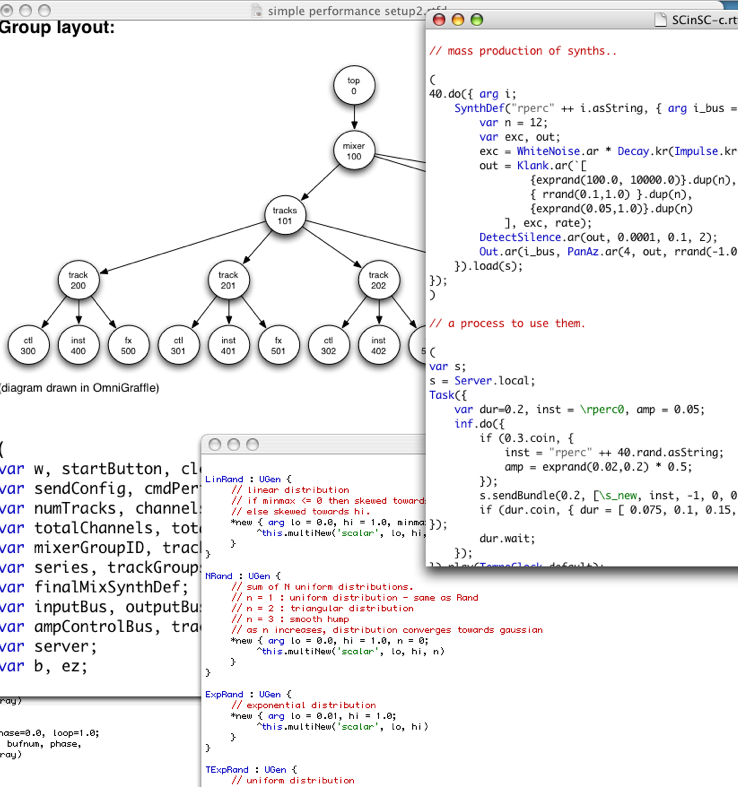
And I find putzing around inside quite fascinating even though I don’t really know how to drive it yet. It even shares vague syntactical similarities with PHP.
So then a funny thing happened earlier this year among SuperCollider users: presumably as equal parts a show of coding virtuosity and a means of much-needed social interaction, the finest among them started sharing their sound creation codes using Twitter, which obviously meant that a complete idea had to be executed in under 140 characters (in some cases even leaving room for the #supercollider hashtag, which is of course all the more impressive). Some of them are quite captivating, all things considered. Immediately after submitting my ballot, I fully intended to write my own 140-character tidbit by the time the issue came out, but damn, this shit is hard! Not quite there yet, unfortunately. So instead…
By Batuhan Bozkurt: play{AllpassC.ar(SinOsc.ar(55).tanh,0.4,TExpRand.ar(2e-4, 0.4,Impulse.ar(8)).round([2e-3,4e-3]),2)};// #supercollider with bass please… [mp3] By Micromoog: play{VarSaw.ar((Hasher.ar(Latch.ar(SinOsc.ar((1..4)!2),Impulse.ar([5/2,5])))*300+300).round(60),0,LFNoise2.ar(2,1/3,1/2))/5}//#supercollider [mp3](As far as I can tell, the code is also the title of the piece, which is either cute or infuriating, depending.)
A sort of best-of was promptly curated by UK tweako-tune mag The Wire for digital release (aka “woohoo we made a zip file!”) as SC140. I am sure you’ll be shocked to learn that I’m the only guy who voted for it.

Still stuck on the prehistoric animals: my recent profile of indie-pop duo Dinosaur Feathers in the Village Voice works in a quick homage to an old forgotten storybook, one of my childhood favorites, which narrated a day in the life of the highly unusual dino-bird Archaeopteryx. (This here would be the opening illustration.)
“I wanted to create something that seemed sort of fantastical, but when you broke it down into its elements, was still very organic,” explains [frontman Greg] Sullo, who immediately thereafter describes “taking a look back at those old ’50s and ’60s songs and reimagining them with modern technology that the Beatles and Os Mutantes didn’t have.” Either way, Dinosaur Feathers are evolving nicely—from this summer’s free-download Early Morning Risers EP to the full-length scheduled for March—but Sullo still worries about his favorite paleontological theory. “It’ll be interesting to see where that information goes in 20 years,” he says. “I wonder how much of it is getting into literature and textbooks and the sort of books you’d have as a kid. Maybe we can do our part to help.” Not necessary, guys: It’s already out there… More
Starting here, with my review of the 2005 Four Tet album Everything Ecstatic, I’m now writing for eMusic. I find this, to put it mildly, absolutely thrilling.
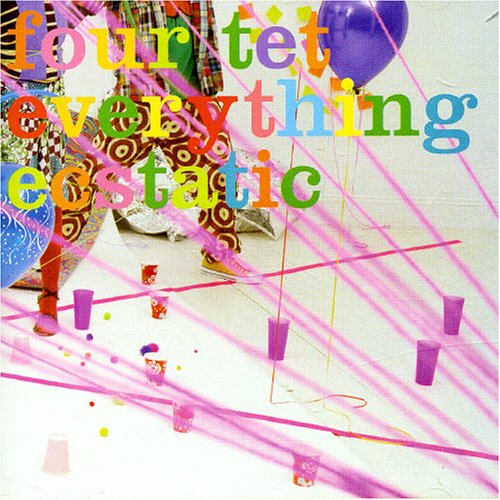
One of Kieran Hebden’s more aggressive outings under the Four Tet moniker, Everything Ecstatic veers away from the rustic acoustic guitar loops which, for better or worse, came to represent his earlier work. Here, he replaces those sounds with low-pitched synth rumbles, buried beneath the drum machines like the unrelenting drone of a factory assembly line. More
As an aspiring music writer, I’m always following bylines and tracking other writers as they hop around between publications, which is why I was able to conclude long ago that eMusic’s editorial division is probably the strongest on the internet. I’m still a little woozy at the thought that I’m now part of it myself. Since I know most people don’t obsess over critics the way I do, a quick run-down of some of the other eMusic contributors whose work I’ve admired elsewhere:
It’s really amazing that they’ve been able to collect all these heavyweights under one masthead. Most dizzying of all, though:

That’s right, I’m now writing alongside Kurt Loder, whose MTV News briefs were a staple of my after-school vegging-out through the 90’s and present every step of the way — prodding me along, actually — as I grew to become an obsessive music fan.
Here’s the thing, though — eMusic isn’t, as you might think, a music magazine.
Rather, it’s an MP3 download store in the vein of iTunes. Its prices are considerably lower, however, and its catalog is heavily skewed toward indie labels. Particularly in the earliest days of the digital music Wild West, it made for a much more customer-friendly download service than Apple’s. For one thing, the audio encoding algorithms were better, a detail about which I care quite a bit, and there wasn’t any Digital Rights Management, a sort of catch-all term for the various forms of nefarious copy protection horseshit that the major labels once demanded the download stores employ before they’d permit inclusion of their tracks. Your previous purchases could even be downloaded repeatedly if need be — say, in the event of a hard drive crash or laptop theft.
Most striking of all, though, was that rather than $1 a-la-carte purchases, a low monthly subscription fee would get you unlimited access to the catalog, meaning that you could explore new music with reckless abandon. A few people used to complain about the selection, which excluded almost all major label content, but I’d just run searches for phrases like “Best Of” and “Greatest Hits,” and the results would overflow with guys like Hank Williams and Nusrat Fateh Ali Khan and Andrew Lloyd Weber — all hugely influential artists that I felt compelled to teach myself about even if they were off the beaten path. With said path being beaten mostly by dolts like My Chemical Romance, it was hard for me to see this as a problem.
eMusic started enforcing monthly limits on customer downloads in 2004 after independent music became hip again and the site’s popularity increased accordingly, which was unfortunate for the customers, but an understandable move overall because the free-for-all obviously wasn’t financially sustainable if proper royalties were to be paid out to the artists. The landscape has changed a lot since then, but even though iTunes has since dumped DRM and doubled its audio encoder bitrates, and even though eMusic has since increased its prices and embraced major label content, I still think they’re doing something remarkable. If you haven’t already, go check out the page on which my review appears and/or one of the artist pages. You will, in a manner of speaking, see the entire internet at a glance.
I spend a lot of time navigating the intersections between art and technology, and can unequivocally say that eMusic’s site is a case study in awesome. They’re able to pull in data from other places — Wikipedia, YouTube, Flickr, the All Music Guide — by sending queries through cross-site connection protocols called APIs. (That’s “application programming interface,” not “Automated Processes, Inc.,” although I can see where the ambiguity comes from.) For example, if they send an artist’s name as specified by the All Music Guide’s API, they might get his bio in return, and then by doing the same per YouTube’s instructions, they can return all his related video embeds.
This is all then rendered as part of the page content, and the effect of so many API’s working successfully and in synchrony is quite breathtaking, producing an evolving aggregate snapshot of the music you’re inquiring about compiled from sources all over the internet. At the risk of sounding like a raving partisan lunatic, especially given my earlier thoughts regarding their other writers, eMusic’s may be the most technically remarkable, staggeringly efficient music discovery platform I’ve encountered. In fact, though I’ve let my payments lapse on a couple occasions — mostly because the music submitted for the coverage I was writing for The Hook had piled up ominously — I’d usually still log in and browse around even though I couldn’t download anything. eMusic might not be able to offer unlimited downloads the way they once did, but the site makes for a very compelling substitute.
As for the ways in which the art — by which I mean both my writing and the songs I write about — collides with the technology, it’s pretty clear to me that eMusic considers their writers an important part of the equation. Just as the writer in me is thrilled about getting filed away alongside Kurt Loder, the geek in me is excited to watch as the writer gets a seat right next to the Wikipedia API. Welcome to the machine, and so forth.
A couple quick follow-ups regarding my article about Anamanaguchi in last week’s Village Voice:
First, although I’ve been published by the Voice a few times before, that was the first article which was long enough to get me into the table of contents. It’s crazy to see my own name next to those of Rob Tannenbaum, Tom Robbins, J. Hoberman, and of course Michael Musto.
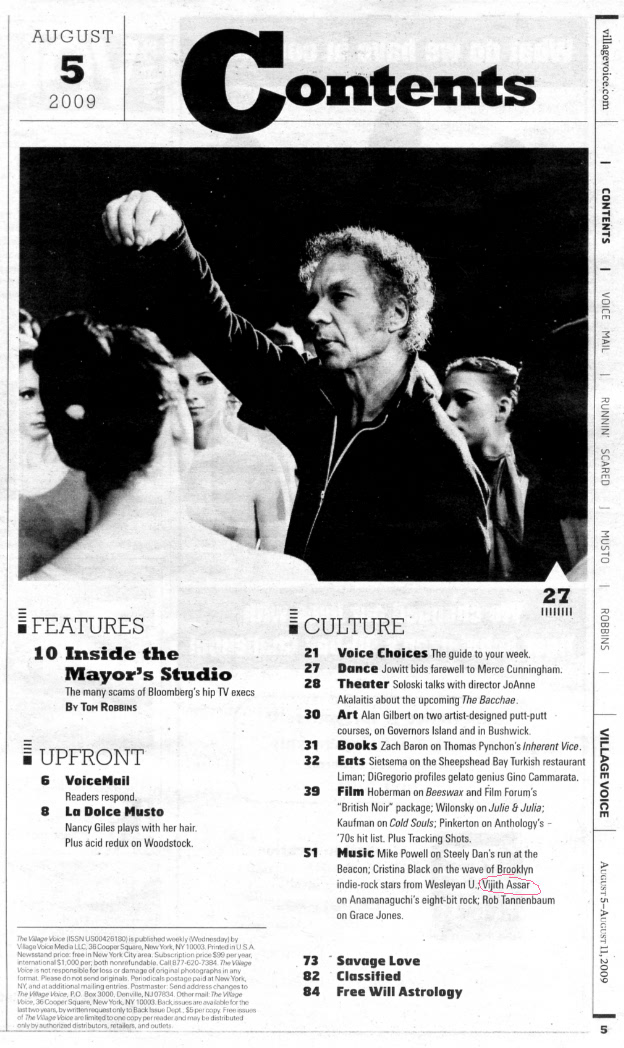
Second: predictably, the Anamanaguchi guys and I spent a lot of time discussing synthesizers during the interview, but since that material wasn’t really appropriate for the Voice, I instead sent the tech talk to Create Digital Music, an awesome and remarkably high-traffic niche blog which consistently publishes some of the best coverage of music technology you’ll find anywhere.
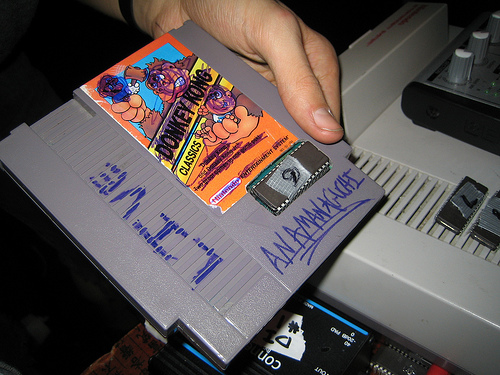
Vijith: Do you write using a guitar or a Nintendo? Pete: The music is pretty melodic, so it’s pretty transferable from instrument to instrument. Anything I write on guitar I can put on the Nintendo, and anything I write on the Nintendo I can usually play on guitar – unless it’s way too fast, which it usually is. More
Even speaking strictly as a reader, I really can’t recommend CDM highly enough; publisher Peter Kirn is both a music software programmer and, by day, a professional writer, so the posts are always informed, insightful, and far more literate than most studio trade rags. If your interest in creative technology tends elsewhere, you may want to check out Peter’s other sites instead, including Create Digital Motion, which is aimed at animators and visual artists, and the community-oriented Noisepages.
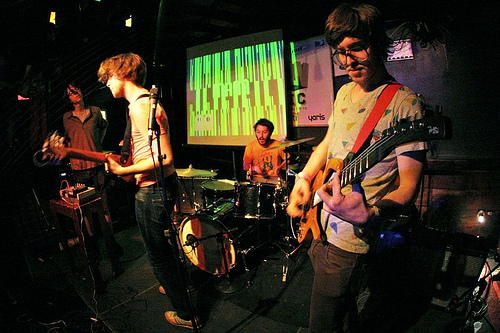
In this week’s Village Voice, I profile Anamanaguchi, a four-piece NYU rock band in which piece #5 is a customized NES console which has been programmed to spit out complicated sequences of lo-fi beeps while the other band members play along with the more obvious instruments.
This is not as nerd-niche-y as it may sound. Ratatat turned into one of last year’s more curious indie-rock success stories by conjuring texturally comparable Fire Flower and 1-UP noises via guitars and keyboards; in 2007, Timbaland himself was caught illegitimately sampling an obscure chiptune composer for a Nelly Furtado backing track. Meanwhile, gamers have also grown more musically engaged through titles like Rock Band and Dance Dance Revolution, boosting the career of Guitar Hero–buoyed metalheads DragonForce, suggesting a massive built-in fanbase ripe for the harvesting. If chiptune does finally go mainstream, Anamanaguchi will surely lead the charge. More
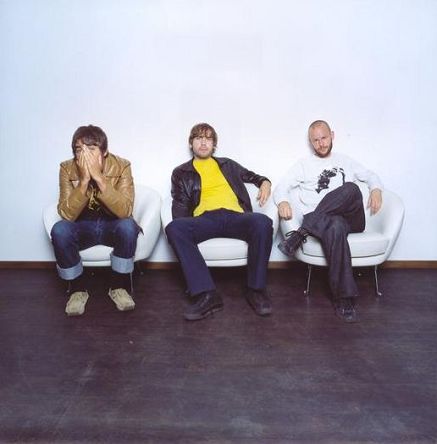
I just reviewed last night’s impressive performance by Peter Bjorn and John for the Village Voice.
Even their most immature tunes were updated with startling verve and grandeur. Foremost among these was “Living Thing,” which turned into an energetic cross between “Not Fade Away” and “The Lion Sleeps Tonight.” Second place goes to “Object Of My Affections,” if only because of its audience participation segment, which somehow actually had everyone clapping on the correct beats. “Young Folks” didn’t fare nearly as well; ever heard several hundred people try to whistle in unison? “Lay It Down” drew some cheers with unruly lines like “Shut the fuck up, boy/You’re starting to piss me off.” But it wasn’t a fight song, or at least not a serious one — it was a party anthem, the sort of drunken spat between friends that gets worked out the next morning over hangovers and cold Pop-Tarts. Carpe diem, kids; even the worst memories from the best years of your life are worth holding onto. More

Glenn McDonald has once again done a remarkable statistical analysis of this year’s Village Voice Pazz and Jop poll. I have stats now, just like a baseball card!

At PopMatters, a review of Blipfest 2008, the largest chiptune show of the year.
I’ve fiddled with the programming enough to know that this stuff doesn’t come easily. There’s a certain sameness to a lot of it on the surface—all lo-fi electronic music in 4/4 with house-derived “drum” sequences which rely on filtered white noise—but after taking in a couple of sets, the differences between the artists become more readily apparent. Bucket-headed spaz-dancer Sulumi’s restless melodies were a fantastic highlight, skipping across the room like so many chips of shale across a Mario 2-2 swimming level, but geek-chic Asian chick Bubblyfish had the most depth, with an enthralling opener which expertly transitioned from jovial Katamari plinks to ominous Metroid gloom over the course of ten minutes. More

In the Village Voice, Pazz and Jop 2008, the long-running annual music roundup in which I was invited to be a small blip myself.
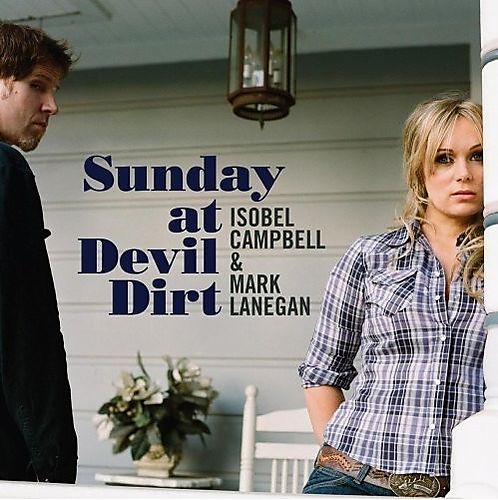
I have a review of the new duo album from Isobel Campbell and Mark Lanegan in this week’s issue of the Village Voice yes you read that correctly the Village Voice.
Although Devil Dirt has its rewarding moments, they’re usually matters of arrangement rather than execution or personality, which means it’s more about the chemistry of boy-meets-girl than about the specific boy or girl. That’s unfortunate, because both Lanegan and Campbell have tremendous track records that might congeal brilliantly if they’d just get over themselves and stop trying to coast on the strength of the premise. More